
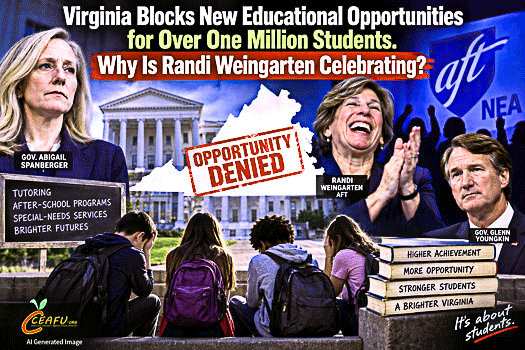
Virginia Blocks New Educational Opportunities for Over One Million Students. Why Is Randi Weingarten Celebrating?
Virginia Blocks New Educational Opportunities for Over One Million Students. Why Is Randi Weingarten Celebrating?
Gov. Abigail Spanberger is refusing to complete the steps Gov. Youngkin set in motion that Virginia students need to participate in the new Federal Scholarship Tax Credit program. Instead of asking how these privately supported scholarships could help public-school students obtain tutoring, special-needs services, and other educational opportunities, AFT-NEA teachers’ union advocates are applauding the decision.
There is something disturbing about celebrating when an estimated 1.37 million Virginia students will be denied this educational opportunity.
That is the troubling image emerging from Virginia’s fight over the new Federal Scholarship Tax Credit, commonly known as the Education Freedom Tax Credit.
Former Gov. Glenn Youngkin began the process of putting Virginia into the federal program. The IRS still lists Virginia among the states that elected to participate for 2027.
But Gov. Abigail Spanberger has said her administration will not take the remaining steps necessary to complete Virginia’s participation.
And American Federation of Teachers President Randi Weingarten has joyously applauded the governor’s position.
The question for Virginia parents should be simple:
What exactly are these teacher unions celebrating?
If Virginia fails to complete its participation application, an estimated 94.2% of Virginia’s children are being denied an educational opportunity.
Why punish the children? Education is not a jobs program it is supposed to be an education program for the America’s children.
This Is Much Bigger than just Tuition
Opponents frequently frame school-choice programs as a struggle between public schools and private schools.
But the Governor’s and Weingarten’s phony framing hides an important feature of this program.
The Federal Scholarship Tax Credit can support qualified elementary and secondary education expenses that extend beyond private-school tuition.
Federal law includes academic tutoring among qualified K–12 educational expenses. It also includes special-needs services for qualifying students, books, supplies, and equipment. Certain supplementary services, including extended-day programs, are included when they meet the statutory requirements.
That matters because these opportunities aren’t limited to children who leave public schools.
Virginia reporting on the federal program specifically notes that scholarship-granting organizations can use scholarship funding for tutoring for children attending local public schools, along with other eligible educational services.
So imagine a Virginia student who remains enrolled in his neighborhood public school but is struggling with mathematics.
Additional tutoring could help.
Imagine a child with an educational disability whose family needs additional services.
Those services could potentially qualify.
Imagine a student who needs additional academic instruction beyond the normal school day.
Federal law expressly recognizes academic tutoring and, under specified circumstances, extended-day programs among qualified K–12 expenses.
These aren’t attacks on public education.
They are additional opportunities to educate children.
A Scholarship Doesn’t Require a Child to Abandon Public School
That fact makes one of the Spanberger administration’s principal arguments especially difficult to understand.
Her administration has said:
“Public money should go to public education.”
It has also said that it has not seen evidence that the program would benefit students in Virginia’s public schools.
But the federal program itself allows qualified scholarship expenditures that can help children who attend public schools.
The real choice therefore is not simply:
Public school versus private school.
For some families, the choice could instead be:
Public school alone versus public school plus added tutoring or other qualifying educational assistance.
Why should Virginia prevent its families from having the second choice?
These Scholarships Begin with Voluntary Contributions
There is another important distinction.
The program is not structured as a direct federal appropriation paying scholarship checks to parents.
Beginning January 1, 2027, an individual can make a qualifying cash contribution to an approved Scholarship Granting Organization, or SGO.
The SGO uses qualifying funds to award scholarships.
The contributing taxpayer can then potentially claim a nonrefundable federal income-tax credit of up to $1,700.
For married couples filing jointly, IRS guidance says each spouse may potentially claim $1,700, for a combined credit of up to $3,400.
In other words:
Private citizen → voluntary contribution → scholarship organization → educational scholarship → student
The federal government encourages those voluntary contributions through its tax code.
That distinction matters when opponents deliberately mischaracterize the program simply as government taking money away from Virginia public schools.
The IRS describes the program as expanding educational opportunities through qualified contributions to Scholarship Granting Organizations.
Virginia Taxpayers Can Still Help Children in Other States
Here is perhaps the strangest result of Virginia’s current position.
The IRS states that individual taxpayers can receive the Federal Scholarship Tax Credit for contributions to qualifying SGOs regardless of the taxpayer’s own state of residence.
So a Virginian can potentially contribute to an approved SGO appearing on another participating state’s list and receive the federal credit.
But an SGO must award its scholarships to eligible students solely within the state associated with that SGO’s certification.
Think about the practical consequences.
A Virginia taxpayer could potentially receive the federal tax credit for helping finance educational opportunities for students in another participating state while Virginia’s own government refuses to complete the process necessary to make the program available to Virginia students.
Whatever one’s position on school choice, that result deserves serious scrutiny.
Virginia families certainly deserve an explanation.
More Than One Million Virginia Students Could Be Affected
And this isn’t a small population.
The American Federation for Children estimates that 1,371,656 Virginia students, representing 94.2% of Virginia’s K–12 population, meet the program’s student-eligibility criteria.
That estimate should be understood correctly.
It does not mean 1.37 million Virginia children would automatically receive scholarships.
Scholarships would depend upon eligible students applying, participating in scholarship organizations, available donated funds, and the organizations’ scholarship decisions.
But the number illustrates the program’s extraordinary potential reach.
We’re talking about educational opportunities potentially available to an exceptionally large share of Virginia’s K–12 population.
That makes celebrating Virginia’s refusal to move forward especially difficult to understand.
Randi Weingarten Says It’s “the Right Call.” Right for Whom?
Randi Weingarten‘s reaction deserves particular scrutiny.
The issue isn’t that the AFT president used vulgar language.
She didn’t.
The troubling part is the celebratory reaction to a decision that could deny Virginia students access to additional educational opportunities.
That should raise an obvious question:
What exactly is being celebrated?
Is a Virginia public-school student better educated because an added tutoring choice has been taken off the table?
Does preventing a child from receiving more academic assistance improve his classroom?
Does denying families access to another source of educational help improve reading achievement?
Does it improve mathematics achievement?
Does it make any teacher more effective?
If the answer is yes, supporters of Virginia’s decision should explain how.
CEAFU has seen no evidence proving that preventing Virginia families from participating in these scholarships will improve those educational outcomes.
Nor should anyone simply assume that Virginia’s decision benefits AFT members.
If Weingarten or the AFT believes preventing these scholarships advances teachers’ interests or improves public education, they should explain the connection.
That is the debate parents deserve.
Education Policy Should Be About Children, Not Systems
A fundamental distinction too often disappears from debates over school choice.
Supporting public schools and supporting every policy favored by public-school organizations are not synonymous.
Public schools matter.
Good teachers matter.
Strong classrooms matter.
But children come first.
An education system exists to educate children. Children do not exist to sustain an education system.
If a Virginia fifth grader needs tutoring, the relevant question should be whether tutoring helps that fifth grader.
If a high-school student needs additional academic instruction, the question should be whether that instruction advances the student’s education.
If a child with special needs can obtain additional qualified services, the question should be whether those services help that child.
The organizational identity of the provider should not matter more than the educational result.
Virginia Had Already Taken the First Step
Another important piece of this story remains.
Virginia didn’t simply ignore the federal program.
Under former Gov. Glenn Youngkin, Virginia took an early step toward participation.
The IRS currently lists Virginia among the states that elected to participate in the Federal Scholarship Tax Credit for 2027.
IRS guidance nevertheless makes clear that state participation also involves reviewing and certifying qualifying Scholarship Granting Organizations and submitting an annual SGO list.
The Spanberger administration has said it will not complete Virginia’s participation.
That decision now stands as the obstacle between Virginia families and a program intended to begin January 1, 2027.
Give Virginia Parents the Choice
Virginia doesn’t need to tell every family to use a scholarship.
It doesn’t need to tell every student to attend a private school.
It doesn’t need to tell every public-school student to hire a tutor.
It simply needs to allow qualifying families to have the choice of using the money the best way possible for their children.
Let parents decide whether tutoring would help their child.
Let families investigate additional educational services.
Let scholarship organizations compete to help students.
Let donors voluntarily support those scholarships.
And let the results speak for themselves.
If Virginia’s leaders believe these educational opportunities wouldn’t help children, make that case to parents.
But don’t take the opportunity away and then celebrate the result.
Randi Weingarten may call Virginia’s decision “the right call.”
Virginia parents are entitled to ask a much more important question:
Right for whom?
Because when government closes the door on tutoring, supplemental instruction, and other educational opportunities that could help children, the people on the other side of that door aren’t political organizations.
They’re students being deprived of educational opportunities.

If you want out of a teachers’ union or any other, visit the National Right to Work Legal Defense Foundation. They have helped public sector employees like Mark Janus, and they can help you exercise your rights too.
___________
ORGANIZED SOURCES
1. Official IRS program page
Use this on the first reference to the Federal Scholarship Tax Credit. It verifies the $1,700 credit, state participation requirement, and SGO structure. Federal Scholarship Tax Credit | Internal Revenue Service
2. Official IRS taxpayer guidance
Best source for the $1,700 individual credit, potential $3,400 married-filing-jointly treatment, and January 1, 2027 start. Federal Scholarship Tax Credit for individuals | IRS
3. Official IRS participating-state list
This is particularly important. As of November 13, 2026, the IRS list explicitly includes Virginia, and it also says taxpayers can receive the credit for contributions to approved SGOs regardless of their own state of residence. Federal Scholarship Tax Credit participating states | IRS
4. Official IRS SGO requirements
This establishes that an SGO must verify scholarship spending and that recipient students must be solely within the state. IRS requirements for Scholarship Granting Organizations
5. Virginia decision and Spanberger statement
WRIC reports that Spanberger will not complete Virginia’s participation and quotes the administration’s “public money should go to public education” rationale. WRIC: Spanberger says Virginia will not participate
6. Public-school students and extended-day opportunities
WTOP reports that scholarship funds can support private-school tuition but also extended-day programs, special-education services and tutoring for public-school children. WTOP: Federal Scholarship Tax Credit and Virginia
7. Statutory expense categories
The Section 530 text includes tuition, fees, academic tutoring, special-needs services, books, supplies and equipment, as well as certain supplementary services including extended-day programs. 26 U.S.C. §530 qualified K–12 educational expenses
8. The 1.37-million-student estimate
The American Federation for Children estimates 1,371,656 Virginia students, 94.2% of Virginia K–12 students, are eligible. Because AFC is a school-choice advocacy organization, I recommend explicitly attributing the estimate to AFC, as the draft does. AFC Virginia Education Freedom Tax Credit fact sheet
